The mathematics of fulfillment are brutal: a single picking error costs SGD 15-25 to remediate through reverse logistics, customer service, and replacement shipping. When accuracy hovers at 96-97% (the typical rate for manual operations), that one error multiplies across thousands of orders monthly, translating to tens of thousands in preventable losses. Simultaneously, labour consumes 35% of fulfillment costs—and in Singapore’s high-wage market, that figure climbs even higher. For brands scaling in Southeast Asia, the convergence of accuracy problems and rising labour costs creates an operational crisis that demands a different approach. Arrowme Logistics exemplifies this approach by combining technology, infrastructure, and expertise to deliver measurable cost savings and accuracy improvements.
A professional fulfillment warehouse in Singapore systematically addresses both challenges through technology integration, optimized processes, and infrastructure designed for precision at scale. Brands working with dedicated fulfillment partners report 25-35% cost reductions while simultaneously achieving 99%+ order accuracy. This isn’t theoretical—it’s the predictable outcome of implementing barcode verification systems, real-time inventory management, and warehouse automation technologies. This guide reveals exactly how these improvements compound and why ecommerce logistics in Singapore have become the competitive standard for brands scaling across Asia-Pacific.
The Hidden Costs of Manual Fulfillment Operations
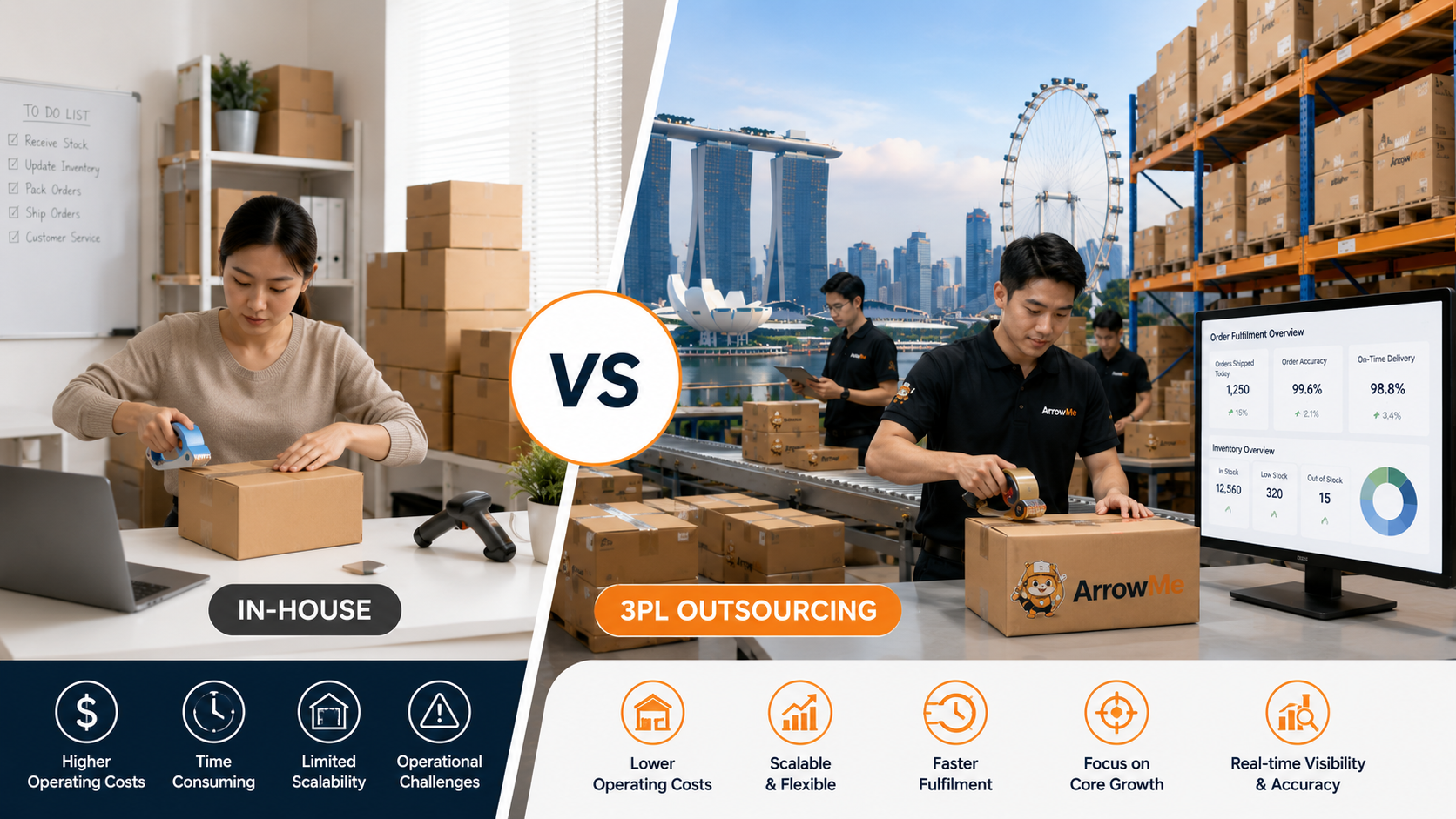
Most growing brands operate fulfillment systems that worked beautifully at 100 orders daily but catastrophically break down at 1,000 orders daily. The problem isn’t effort or commitment—it’s that manual processes don’t scale linearly. Understanding these hidden costs illuminates why outsourcing to a professional fulfillment warehouse in Singapore is often cheaper than operating in-house, even accounting for third-party fees. Arrowme Logistics’ infrastructure demonstrates how economies of scale and technology integration create these cost advantages.
Labour Inefficiency at Scale
When picking is manual, staff navigate the warehouse mentally, remembering SKU locations, calculating quantities, and managing the cognitive load of simultaneously tracking multiple orders. This process succeeds at low volumes but becomes exponentially inefficient as volume increases. Workers spend more time walking to locate items than actually picking them. Picking-to-packing time ratios worsen from 40:60 at low volumes to 20:80 at high volumes. That inefficiency is silent and widespread—it looks like busy staff, but throughput per labour hour plummets.
In Singapore’s labour market, where wage inflation consistently outpaces productivity improvements, manual fulfillment labour costs become unsustainable. A modest 5,000 sq ft warehouse with 15 staff members costs SGD 60,000+ monthly. A properly optimized operation with the same space and barcode-driven workflows requires 8-10 staff, representing SGD 40,000+ in monthly savings—SGD 480,000+ annually before accounting for improving Arrowme Logistics eliminates these inefficiencies through barcode-driven workflows and optimized warehouse layouts that maximize picking efficiency and accuracy.
Inventory Carrying Costs and Obsolescence
Without real-time inventory visibility, the natural human tendency is to over-stock. Buyers see SKU levels appearing “low” in the system (perhaps due to inventory lag from a 6-8 hour batch sync), so they order more. Physical inventory accumulates. Capital that could fund marketing or product development sits idle on warehouse shelves. In Singapore’s warehouse environment, where space is premium and expensive, excess inventory consumes valuable real estate.
Inventory carrying costs run 20-30% of inventory value annually (including storage, insurance, shrinkage, and obsolescence risk). By implementing real-time inventory tracking through inventory management in Singapore systems, brands typically reduce total inventory by 15-25%. For a business with SGD 400,000 in inventory, this translates to SGD 100,000 freed—a 60,000 reduction in annual carrying costs. With Arrowme Logistics’ real-time inventory management, brands achieve these savings while maintaining optimal stock levels.
Picking Errors and Reverse Logistics
Manual picking generates errors at 3-7% rates depending on operational stress. Each error triggers:
- Reverse logistics (customer shipping item back)
- Warehouse processing and quality check
- Replacement order fulfillment
- Refund or credit processing
- Customer service intervention
- Lost opportunity for repeat purchase
The direct cost averages SGD 20 per error. At 3% error rate across 10,000 monthly orders, that’s 300 errors × SGD 20 = SGD 6,000 monthly (SGD 72,000 annually). Implementing barcode verification at the picking stage—scanning each SKU to confirm it matches the order—immediately improves accuracy to 99%+. The same 10,000 orders would generate only 10 errors at SGD 200 annually versus SGD 72,000 with manual operations. Arrowme Logistics’ barcode verification system ensures this level of accuracy across all fulfillment operations.
Overselling and Stockout Situations
When inventory data lags reality by 6-8 hours, overselling happens invisibly. Your ecommerce platform shows “20 units available” when you actually have 15. Customers order 18. Your system registers the sale but you don’t have inventory to fulfill. Customer service must now intervene—apologize, offer partial fulfillment, issue credits, or arrange refunds. Each situation costs SGD 15-30 in labour and goodwill.
Conversely, inventory “ghosts” create phantom stockouts. The system shows zero units available when you actually have product on shelves (perhaps the previous order batch hasn’t synced yet). A sale that would have occurred gets lost. A regional ecommerce logistics hub with real-time systems eliminates both scenarios through continuous inventory synchronization at Arrowme Logistics’ real-time inventory sync prevents both overselling and phantom stockouts, protecting revenue and customer relationships.
Why Order Accuracy Directly Impacts Profitability
The relationship between order accuracy and customer lifetime value is mathematical and unforgiving. Research demonstrates that 20% of customers never return after receiving an incorrect order. For an ecommerce brand averaging SGD 150 order value and 30% repeat purchase rate, a single accuracy failure costs:
Initial order value: SGD 150
Lost future purchases (30% × 5 predicted repeat purchases): 5 × SGD 150 × 30% = SGD 225
Total customer lifetime value lost: SGD 375+
When accuracy is 97% and you process 10,000 orders monthly, that’s 300 errors × SGD 375 = SGD 112,500 in lost customer lifetime value monthly. That’s SGD 1.35 million annually—an expense that doesn’t appear on your fulfillment cost sheet but devastates your business model.
Improving accuracy to 99% reduces errors from 300 to 100 monthly, saving SGD 75,000 monthly or SGD 900,000 annually in retained customer lifetime value. This single metric dwarfs any cost associated with implementing barcode systems or partnering with a professional fulfillment warehouse in Singapore. Arrowme Logistics provides exactly this combination of barcode accuracy and professional infrastructure.
How Modern Fulfillment Warehouses Reduce Costs: Seven Mechanisms
1. Real-Time Inventory Visibility Eliminates Carrying Costs
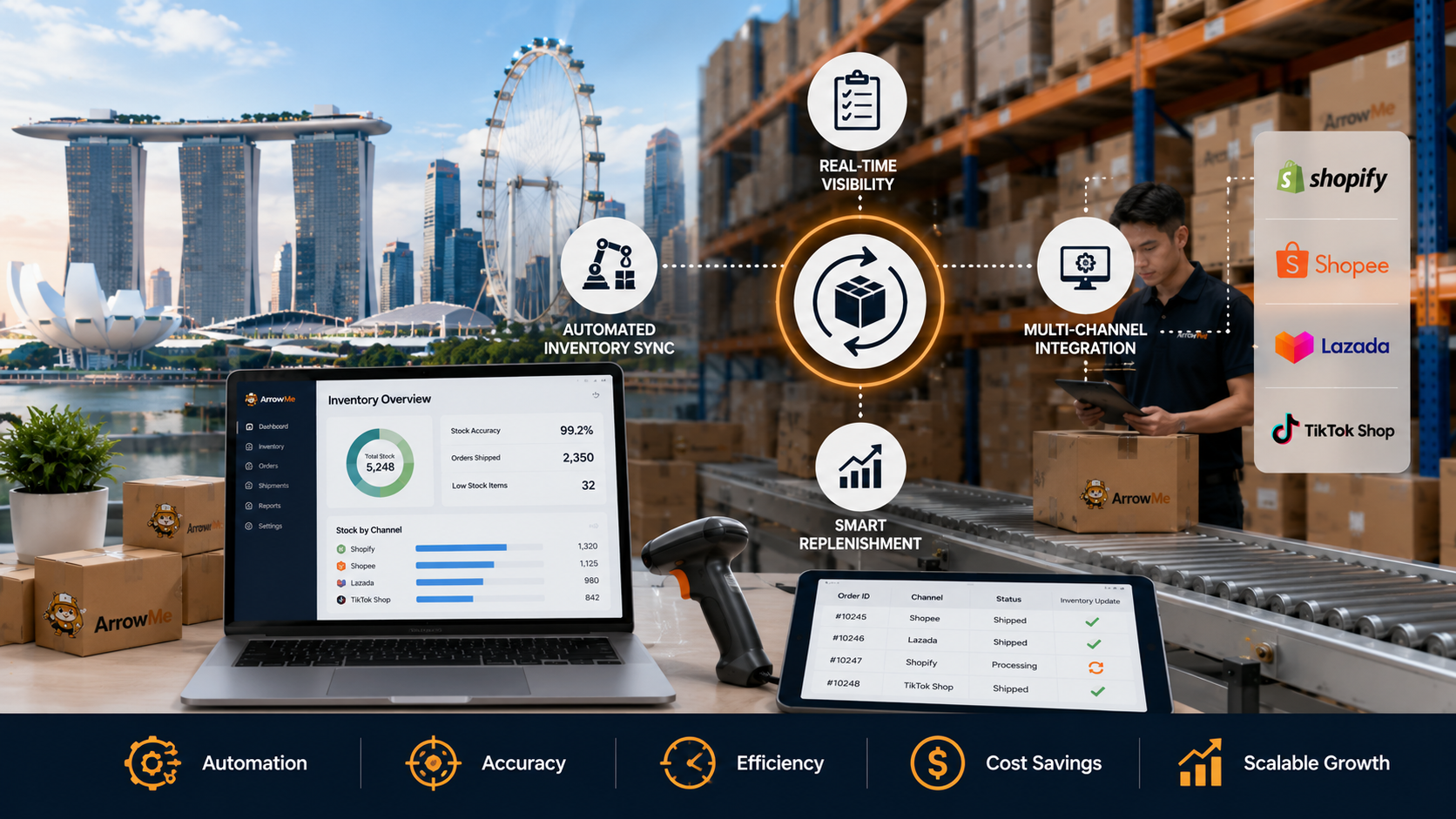
A professional fulfillment warehouse in Singapore integrates with your ecommerce platforms through APIs, maintaining synchronized inventory across all sales channels in real-time. When you process an order on Shopify, your TikTok inventory updates instantly. When you receive stock from suppliers, the system immediately reflects availability. This eliminates the 6-8 hour lag that creates overselling and overstocking.
With accurate real-time visibility, demand forecasting becomes predictive rather than reactive. AI algorithms analyze historical patterns, seasonal trends, and current sales velocity to predict inventory needs 7-30 days forward. Replenishment triggers automatically before stockouts occur. Inventory optimization reduces excess stock by 15-25%—directly reducing carrying costs.
Impact: Reduce inventory by 20% = SGD 80,000 freed from inventory (at SGD 400,000 base) × 25% carrying cost rate = SGD 20,000 annual savings
2. Barcode Verification Achieves 99%+ Accuracy
Every picking operation includes barcode scanning. Staff scan the SKU from the shelf and scan the order barcode—the system confirms they match. If they don’t match (wrong product, wrong quantity), the system prevents the pick and alerts the staff member. This simple verification layer removes ambiguity and human error simultaneously. Arrowme Logistics implements this barcode verification at every picking stage to guarantee accuracy.
Accuracy improves from 96-97% (manual) to 99%+ (barcode-verified) immediately. Returns drop 70-80%. Customer satisfaction scores improve. But the financial impact is massive: fewer returns means fewer reverse logistics shipments, fewer refunds, fewer replacement orders, and—critically—more customers retained for future purchases.
Impact: Reduced returns from 4% to 1% on 10,000 orders = 300 fewer returns monthly × SGD 20 cost per return = SGD 6,000 monthly savings. Plus, 300 customers retained at SGD 375 lifetime value = SGD 112,500 additional retained value monthly.
3. Wave Picking Optimizes labour Productivity
Instead of fulfilling orders individually (requiring staff to traverse the warehouse multiple times), modern warehouses implement wave or batch picking. The system groups 20-50 orders together and generates an optimized pick sequence based on warehouse zones. Staff pick all items for this batch in a single efficient path, then the batch moves to packing.
This optimization reduces picking time per order by 40-50% while simultaneously improving accuracy (fewer backtracking decisions, more focused workflow). A warehouse that previously processed 50 orders per labour hour now processes 75-80.
Impact: Increase throughput from 50 to 75 orders/labour hour = 50% productivity improvement. At SGD 15-20/hour labour cost, this reduces labour cost from SGD 0.80/order to SGD 0.53/order—a 34% reduction in picking labour costs.
4. Warehouse Automation Scales Without Proportional labour Increases
Impact: Automation increases throughput by 40-50% while actually reducing labour needs slightly. What previously required 15 staff members now requires 12-13, while processing 50% more volume.
5. Cross-Docking Eliminates Unnecessary Storage
Cross-docking is a warehouse technique where incoming inventory bypasses warehouse storage entirely—it’s unloaded from inbound shipment and immediately loaded onto outbound shipments. This eliminates storage space requirements, handling labour, and inventory carrying costs while accelerating delivery.
Ecommerce fulfilment in Singapore leveraging cross-docking sees 30-40% reductions in warehouse space requirements for fast-moving inventory. For brands with limited warehouse access or premium real estate costs, this technique provides immediate relief.
Impact: Reduce warehouse space needs by 30% for 40% of inventory = 12% total space reduction × SGD 15/sq ft annual cost = SGD 1,800 annual savings per 1,000 sq ft. For a 5,000 sq ft facility, this equals SGD 9,000 annually.
6. Just-in-Time Replenishment Reduces Safety Stock
Traditional inventory management maintains safety stock to buffer against demand uncertainty. Just-in-Time (JIT) systems eliminate this buffer through predictive analytics and frequent, small replenishment shipments. When you can accurately forecast demand 7-14 days forward and receive replenishment stock within that window, safety stock becomes unnecessary.
Implementing JIT through inventory management in Singapore reduces inventory by an additional 10-15% on top of carrying cost reductions from visibility. Combined with other optimizations, total inventory reduction reaches 25-30%.
Impact: Additional 10% inventory reduction × 25% carrying cost = 2.5% total fulfillment cost reduction
7. Real-Time Analytics Enable Continuous Optimization
A professional fulfillment warehouse in Singapore provides real-time dashboards tracking picking accuracy, order cycle time, labour productivity, shipping time, and cost per order. Unlike monthly reports (which arrive too late to fix problems), real-time data enables daily decision-making.
When accuracy dips from 99% to 97.5%, management immediately identifies which products or SKUs are causing errors. When labour productivity drops, the system flags which picking zones are inefficient. This continuous feedback loop enables perpetual improvement.
Impact: 5-10% continuous efficiency improvement from data-driven decision-making, compounding monthly.
The Accuracy Advantage: Why 99%+ Matters
Beyond the customer lifetime value impact, achieving 99%+ accuracy provides competitive advantages:
Premium Positioning: Brands can credibly claim “99.5% accuracy guarantee” in marketing—a differentiator that justifies premium pricing.
Reduced Churn: Fewer dissatisfied customers means higher repeat purchase rates and better NPS scores. Satisfied customers become advocates.
Operational Efficiency: Fewer errors mean fewer customer service interactions, smaller support team, and lower support costs.
Scaling Advantage: As you scale to thousands of daily orders, accuracy becomes more difficult to maintain manually. Brands using systems-driven accuracy scale smoothly; manual brands hit accuracy ceilings and can’t grow further without massive quality investments.
Marketplace Performance: On Lazada, Shopee, and other marketplaces, seller ratings directly impact visibility. Accuracy and on-time delivery are rating factors. Higher ratings mean better placement, more visibility, more sales.
Best Practices for Maximizing Warehouse Efficiency
1. Implement Real-Time Integration
Ensure your fulfillment warehouse in Singapore integrates with your ecommerce platforms, payment processors, and shipping systems through APIs. Real-time data flow eliminates lag and enables unified operations.
2. Use Directed Picking
Don’t allow staff to create their own picking routes. Warehouse management systems should generate optimized pick sequences that minimize travel time and simplify decision-making.
3. Barcode Everything
Every SKU, every pallet, every location should have a barcode. This provides absolute verification and enables real-time inventory tracking. RFID tags go further, enabling touchless tracking.
4. Implement Cycle Counting
Stop conducting annual physical inventories. Instead, continuously count inventory in small batches. This maintains 99%+ accuracy without disrupting operations.
5. Zone or Wave Picking
Group orders by warehouse zone or processing wave. This reduces congestion and improves accuracy compared to individual order fulfillment.
6. Monitor KPIs Obsessively
Track these metrics daily: Order Accuracy Rate (target 99%+), Perfect Order Rate (target 99%), Order Cycle Time (target 24 hours), Inventory Accuracy (target 99%), Damage Rate (target <1%), Cost Per Order, and labour Productivity. Use this data to identify improvement opportunities.
7. Partner with Specialists
For most scaling brands, outsourcing to a professional 3PL provider is more cost-effective than building in-house. Professional providers operate sophisticated infrastructure and technology that individual brands can’t justify.
How much can we realistically save by switching to a professional fulfillment warehouse?
How quickly can we improve accuracy?
What's the difference between working with a 3PL vs operating our own warehouse?
Can we transition without disrupting service?
How does a fulfillment warehouse handle our brand's requirements?
What about returns processing?
The Competitive Imperative
In Singapore’s competitive ecommerce landscape, fulfillment has become a customer expectation, not a differentiator. Brands that operate fragmented, manual fulfillment operations can’t scale efficiently. They can’t maintain accuracy. They can’t compete on speed. They lose to brands with professional logistics infrastructure.
ecommerce logistics in Singapore is no longer a back-office function—it’s a core competitive capability. Brands that modernize their approach through technology, process optimization, and professional partnerships create competitive moats that are difficult to overcome.
The mathematics are compelling: 99%+ accuracy, 25-35% cost reduction, 40-50% faster delivery. These aren’t marginal improvements—they’re transformational changes that determine market winners and losers.
Ready to Transform Your Fulfillment?
The path to sustainable profitability for ecommerce brands runs through operational excellence. Modern fulfillment warehouse in Singapore solutions provide the technology, expertise, and infrastructure to achieve it.
Whether you’re a D2C brand hitting fulfillment constraints, a marketplace seller seeking competitive advantage, or an established player optimizing margins—the answer involves the same foundational shift: moving from manual, fragmented fulfillment to integrated, technology-enabled operations.
Your fulfillment operation shouldn’t constrain growth—it should enable it. The brands winning in 2026 are those that recognized this and moved fast. Arrowme Logistics provides the proven infrastructure, technology, and expertise to make this transformation seamless and profitable.