When your ecommerce business hits that inflection point where orders suddenly surge faster than your fulfillment systems can handle, you’ve discovered what operators call the fulfillment bottleneck—the precise moment growth becomes a liability. Sales accelerate, inventory visibility collapses, shipping delays stretch from hours to days, and labour costs spiral upward without proportional revenue gains. For many brands, this crisis coincides with their biggest sales opportunities, turning potential triumphs into operational disasters. Arrowme Logistics understands that this inflection point requires immediate operational transformation.
The core problem is this: ecommerce logistics in Singapore have evolved dramatically, but most brands are still operating fulfillment systems designed for yesterday’s order volumes. When you lack proper inventory management, real-time order tracking, and warehouse automation, scaling becomes exponentially more expensive and error-prone. This guide reveals exactly how fulfillment bottlenecks form, why they destroy profitability, and how modern ecommerce fulfilment in Singapore solves them systematically. Arrowme Logistics provides advanced fulfillment solutions designed to eliminate these bottlenecks through real-time inventory management and warehouse automation.
What Is a Fulfillment Bottleneck and Why It Occurs
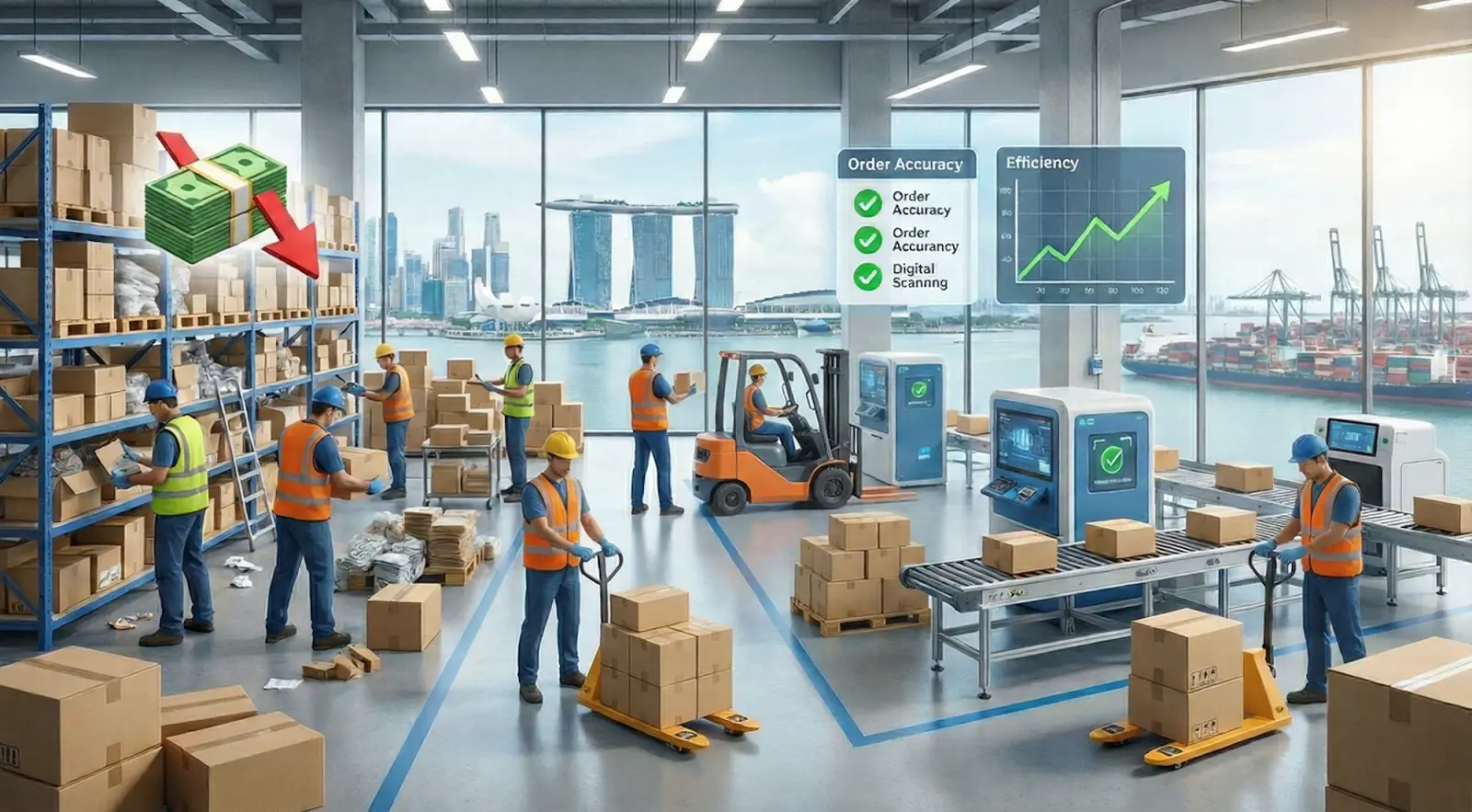
Cascading Impact of Unfixed Fulfillment Bottlenecks on Business Metrics
A fulfillment bottleneck is the operational ceiling where your warehouse systems, staff, and processes can no longer keep pace with order volume. It’s not a single failure; it’s a cascade of compounding inefficiencies that reveal themselves through deteriorating performance metrics. The distinguishing feature is this: the bottleneck emerges precisely when you’re succeeding—when order volume proves your product-market fit but exposes the infrastructure shortcomings you ignored during slower growth periods.
The bottleneck typically develops through four mechanisms:
Manual Processes That Don’t Scale
Early-stage fulfillment works remarkably well with simple, manual workflows: orders arrive, staff pick products from shelves, pack boxes, print labels, and ship. This process succeeds brilliantly at 50 orders daily. At 500 orders daily, the same process breaks down entirely. Why? Manual picking requires staff to navigate the warehouse mentally, remember SKU locations, and manage cognitive load. As volume increases, the ratio of actual picking time to walking time worsens exponentially. Your team is spending more time searching for products and less time actually fulfilling orders. Arrowme Logistics addresses this with optimized warehouse layouts and automated picking systems that scale efficiently.
Disconnected Systems Creating Inventory Lag
When your warehouse management system (WMS) doesn’t integrate with your ecommerce platform in real-time, an invisible but devastating lag emerges. A staff member picks a product, but the system doesn’t update inventory immediately. Your ecommerce platform still shows the item as available for 6-8 hours until the next batch inventory sync. Meanwhile, customers continue ordering the product, creating overselling situations. By the time the system catches up, you’ve committed to delivering inventory that doesn’t exist.
Lack of Directed Workflow Optimization
Even with a WMS, if it isn’t optimizing how orders are prioritized and fulfilled, you’re still relying on staff intuition. Should you fulfill orders by customer, by geographic zone, or by product? Which orders should be prioritized to meet delivery timeframes? Without directed picking algorithms, your team makes these decisions inefficiently, constantly backtracking across the warehouse and missing opportunities for batch efficiency. Arrowme Logistics’ intelligent order management system solves this by automatically routing orders for maximum efficiency.
Capacity Planning Without Data Visibility
You can’t plan for what you can’t see. Without real-time inventory and demand forecasting, you’re flying blind during peak seasons. Inventory sits in some locations while stockouts occur in others. You can’t accurately tell customers when items will be available. You can’t reorder intelligently because you don’t know true demand patterns across all sales channels.
The Business Impact: Why Bottlenecks Are Expensive
Hidden Monthly Costs of Unfixed Fulfillment Bottlenecks (10,000 Orders)
Understanding that you have a bottleneck is one thing. Grasping its true financial impact is another. The costs are staggering and multidimensional:
Customer Experience Deterioration
When fulfillment slows, customer satisfaction plummets. Research shows that 84% of shoppers won’t return after a poor delivery experience. One delayed order or lost shipment isn’t a minor inconvenience—it’s a permanent loss of customer lifetime value. During peak seasons when fulfillment bottlenecks are most severe, you’re simultaneously destroying the customers you most need to retain.
Picking Errors Compound
Under pressure, accuracy collapses. Picking errors increase from 2-3% in normal operations to 7-9% during bottleneck periods. Each error requires expensive reverse logistics: returns processing, potential refunds, replacement shipments, and customer service interventions. A single picking error might cost SGD 15-25 to remediate—expensive at scale.
Inventory Carrying Costs Explode
Without accurate inventory visibility, you hold excess safety stock everywhere. Your buyer sees that you’re “low” on SKU X (based on a system lag), so they over-order. Physical inventory accumulates, tying up capital, consuming warehouse space, and creating obsoletion risk. Inventory carrying costs run 20-30% of inventory value annually; excess stock is literally burning cash.
Labour Costs Scale Faster Than Revenue
This is the insidious trap. As volume increases 20%, you might need 35% more labour because the manual processes have become so inefficient. Walking distances increase, picking time expands, coordination overhead multiplies. Your labour as a percentage of revenue climbs from 8% to 14%. Management teams wrongly blame staff productivity, when the real problem is the system architecture.
Identifying Fulfillment Bottlenecks: Seven Clear Warning Signs
If your business exhibits three or more of these symptoms, you have a fulfillment bottleneck that’s actively destroying profitability:
- Picking Errors Exceeding 97%
Accuracy below 97% despite staff training and process improvements indicates your warehouse has exceeded manual process capability. Directed picking with barcode verification will immediately improve this to 99%+ by removing ambiguity and cognitive load.
- Orders Taking 48-72 Hours to Ship
Your fulfillment target should be 24 hours from order receipt to shipment. If orders consistently age 48+ hours, you have a capacity constraint. It’s not a process problem—it’s a system architecture problem that manual management can’t solve.
- Inventory Discrepancies Between System and Physical
If cycle counts regularly reveal significant gaps between what your system says you have and what’s actually on shelves, you have an inventory lag problem. Real-time inventory management in Singapore requires integrated systems, not spreadsheets or periodic counts.
- Frequent Overselling and Stockouts
If customer service regularly deals with “sorry, out of stock” situations despite inventory showing available, your system lacks real-time visibility. Unified ecommerce fulfilment in Singapore integrates all sales channels (Shopify, marketplace, physical retail) into a single inventory view that eliminates overselling.
- Labour Costs Rising Faster Than Revenue
Track labour as a percentage of revenue monthly. If this ratio has climbed from 8% to 12% over 18 months despite stable processes, your operations are suffering from exponential inefficiency. This is your clearest signal that manual workflows have reached their ceiling.
- Customer Complaints About Delivery Delays
Social media mentions of slow shipping, support tickets citing delayed orders, and diminishing review scores all indicate fulfillment performance has become visible to customers. By this point, you’ve already lost several percentage points of repeat purchase rate.
- Scaling Becomes Exponentially Expensive
If a 10% order volume increase requires 25% more warehouse space, 30% more staff, and 40% more capital investment, you’re operating in the exponential inefficiency zone. A properly architected fulfillment warehouse in Singapore scales linearly or sub-linearly.
How Ecommerce Logistics in Singapore Eliminates Bottlenecks
Modern ecommerce logistics in Singapore provided by specialized 3PL providers doesn’t just move boxes—it fundamentally rewires how fulfillment operates. Here’s how:
Real-Time Inventory Visibility
A professional fulfillment warehouse in Singapore integrates with your ecommerce platforms through APIs, maintaining real-time inventory synchronized across all sales channels. When a customer purchases on Lazada, your Shopify inventory updates instantly. When you receive stock from suppliers, the system immediately reflects availability. This eliminates the 6-8 hour lag that creates overselling situations. Your ecommerce platform never accepts orders for items you don’t physically have.
Directed Picking and Wave Optimization
Advanced warehouse management systems analyze orders and automatically determine the most efficient pick sequence. Rather than fulfilling orders individually (requiring multiple warehouse traverses), the system groups orders by warehouse zones and generates optimized pick waves. Staff pick multiple orders in a single efficient path, reducing travel time by 40-50% and improving accuracy simultaneously.
Barcode and RFID Verification
Every pick is verified against the order. Scan the SKU, confirm it matches the order requirements, and only then place it in the box. This eliminates picking errors immediately—accuracy jumps from 96-97% to 99%+ because ambiguity is removed. RFID systems go further, automatically tracking inventory as it moves through the warehouse without manual scans.
Inventory Allocation by Channel
A sophisticated inventory management in Singapore system allocates inventory by sales channel and unit of measure, preventing the expensive “robbing Peter to pay Paul” dynamic. Inventory is allocated to e-commerce “each” orders and B2B bulk orders based on configured rules, eliminating the need to break cases and pallets for online fulfillment.
Multi-Warehouse Order Routing
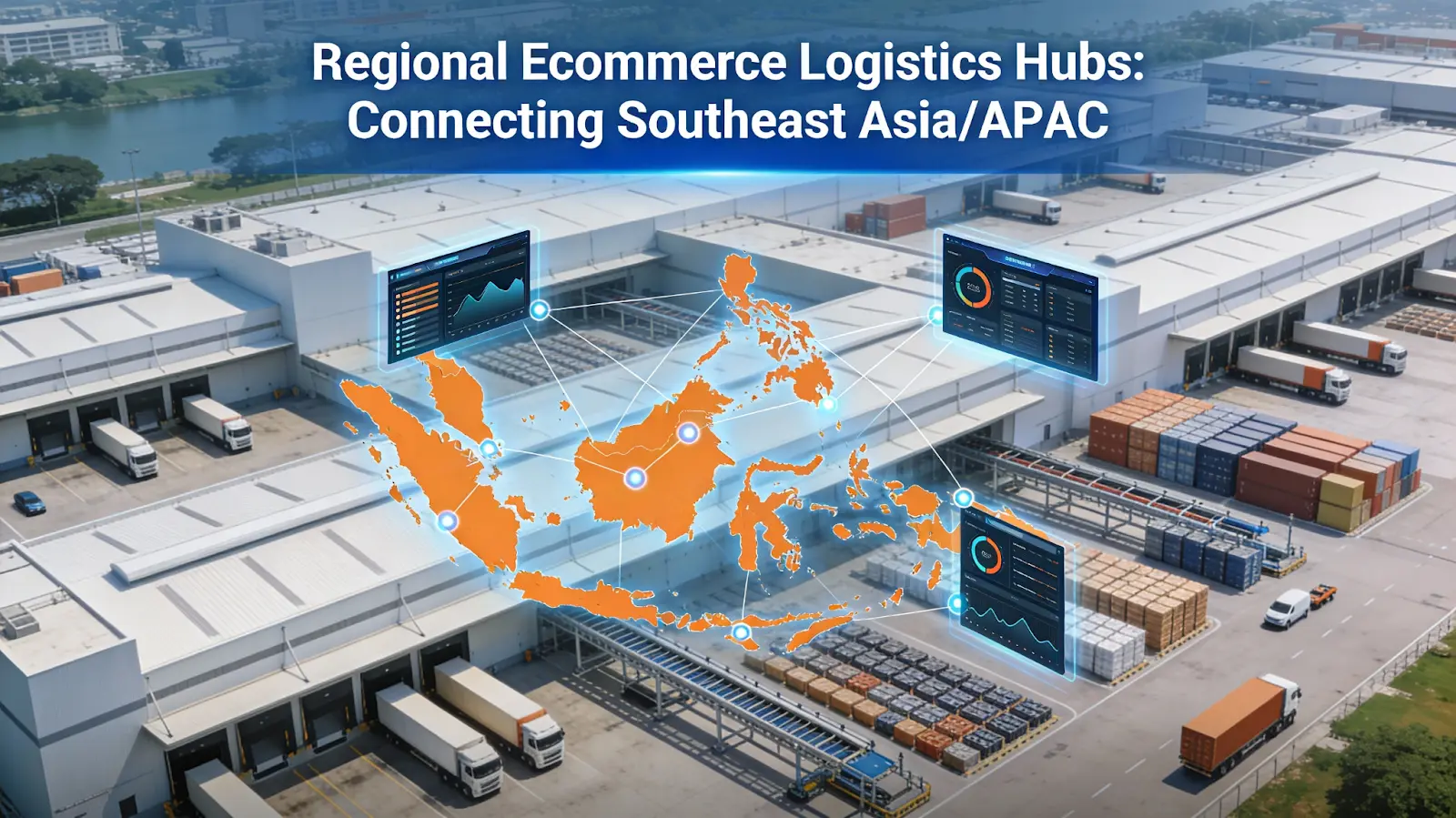
If your regional ecommerce logistics hub includes multiple fulfillment nodes, the system intelligently routes orders to the warehouse closest to the customer or with the best inventory position. This reduces transit times, optimizes shipping costs, and balances warehouse load.
Demand Forecasting and Replenishment
Performance Comparison: Manual Fulfillment vs Optimized Ecommerce Logistics
AI-driven analytics examine historical demand patterns, seasonal trends, and current sales velocity to predict which products you’ll need in 7-30 days. Replenishment is automatically triggered before stockouts occur. You maintain optimal inventory—enough to fulfill demand without carrying excessive safety stock.
Best Practices for Fixing Fulfillment Bottlenecks
1. Implement a Cloud-Based Warehouse Management System
Modern WMS platforms provide real-time visibility, automated workflows, and analytics dashboards. Look for systems with:
- Real-time integration with Shopify, Woocommerce, Amazon, and other ecommerce platforms
- Mobile app access for warehouse staff (crucial for flexibility and real-time updates)
- AI-driven demand forecasting
- Multi-warehouse inventory tracking in a centralized platform
- Automated labour allocation and task assignment
2. Optimize Your Warehouse Layout
Audit your current warehouse layout. High-demand SKUs should be positioned closest to packing stations to minimize picking time. Implement zone picking where different staff members manage specific warehouse areas, reducing congestion and improving accuracy. Seasonal products should be repositioned based on demand velocity.
3. Adopt Barcode or RFID Verification
Implement barcode scanning at every fulfillment stage: receiving, putaway, picking, and packing. This provides absolute verification that the correct item is being processed. RFID goes further, enabling touchless inventory tracking. This single change typically eliminates 80-90% of picking errors immediately.
4. Implement Wave or Batch Picking
Stop fulfilling orders individually. Instead, batch 20-50 orders and fulfill them together through the warehouse. This reduces staff travel time dramatically and allows you to process 40-50% more volume with the same labour. Batch picking by geographic zone or product type generates even greater efficiencies.
5. Create a Unified Inventory View
Integrate all sales channels into a single inventory source of truth. Whether customers purchase through your Shopify store, Lazada, TikTok Shop, or physical retail, they’re consuming from the same inventory pool. This eliminates overselling and provides unprecedented control over inventory allocation.
6. Partner with a Specialized 3PL Provider
For most scaling brands, outsourcing fulfillment to a specialized 3PL provider is more cost-effective than building internal capabilities. Professional 3PLs operate sophisticated infrastructure and technology that individual brands can’t justify. They scale capacity up and down with your demand, absorb peak season surges, and provide geographic flexibility.
7. Implement Cycle Counting and Automated Audits
Stop conducting annual physical inventories. Instead, implement cycle counting where you continuously count inventory in small batches (one warehouse zone per day). Use automated robots with computer vision to read tags and compare against WMS data. This maintains 99%+ inventory accuracy without disrupting operations.
Frequently Asked Questions About Fulfillment Bottlenecks
How quickly can we see improvements after implementing a new WMS?
What's the difference between working with a 3PL vs building fulfillment in-house?
Can we fix bottlenecks without abandoning our current warehouse setup?
How much inventory reduction can we achieve through better management?
What's the timeline for partnering with a 3PL provider?
How do we ensure quality when outsourcing fulfillment?
The Path Forward: From Bottleneck to Scaling
Fulfillment bottlenecks aren’t the result of bad intentions or weak effort. They’re the inevitable outcome of using yesterday’s infrastructure and processes to handle today’s volume. The solution isn’t to work harder or hire more staff—it’s to fundamentally rewire how fulfillment operates.
ecommerce logistics in Singapore has evolved into a sophisticated capability involving real-time inventory integration, AI-driven optimization, warehouse automation, and omnichannel fulfillment orchestration. Brands that leverage these capabilities scale effortlessly. Those that don’t find themselves perpetually constrained.
The decision isn’t whether to modernize your fulfillment infrastructure—it’s when. The longer you delay, the more customer lifetime value you lose to poor delivery experiences and the more capital you waste on inefficient labour and excess inventory.
Ready to Break Free From Fulfillment Bottlenecks?
Your fulfillment operation should be your competitive advantage, not your constraint. Modern ecommerce logistics in Singapore provides the technology, expertise, and infrastructure to scale orders 10x without proportional cost increases or quality degradation. With Arrowme Logistics’ scalable fulfillment infrastructure, businesses can achieve this growth without operational strain.
Whether you’re a D2C brand crossing the 1,000 orders/day threshold, a scaling marketplace seller, or an established player seeking to optimize margins, the path forward involves the same foundational shift: moving from manual, fragmented operations to integrated, technology-enabled fulfillment. Arrowme Logistics specializes in this exact transition, helping businesses implement automated workflows and integrated systems.
The bottleneck you’re experiencing today is fixable. The question is whether you’ll fix it proactively before customer satisfaction deteriorates further, or reactively after you’ve lost significant market share to competitors with smarter fulfillment operations. Partnering with Arrowme Logistics ensures you fix bottlenecks proactively before they impact your bottom line.