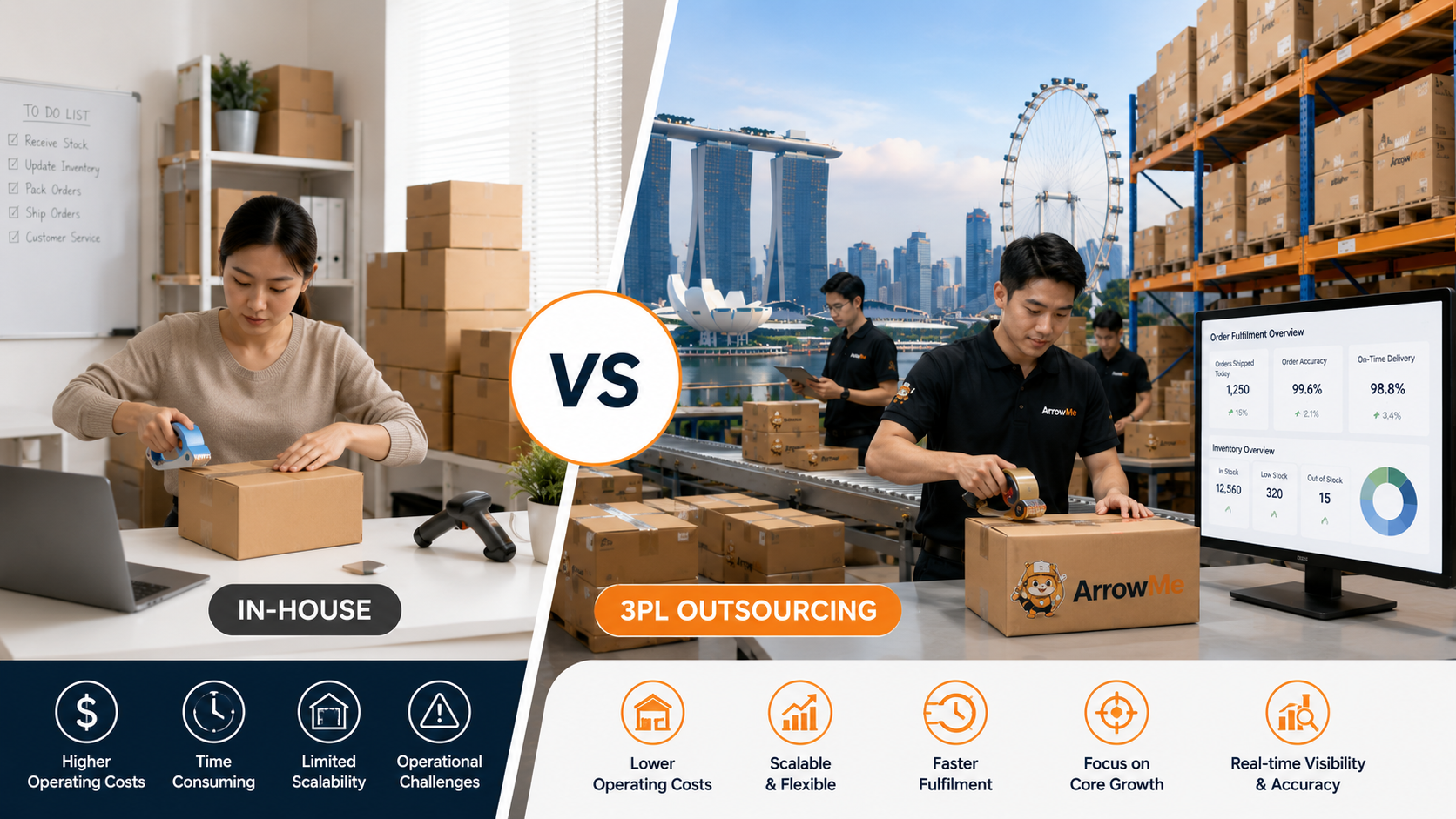
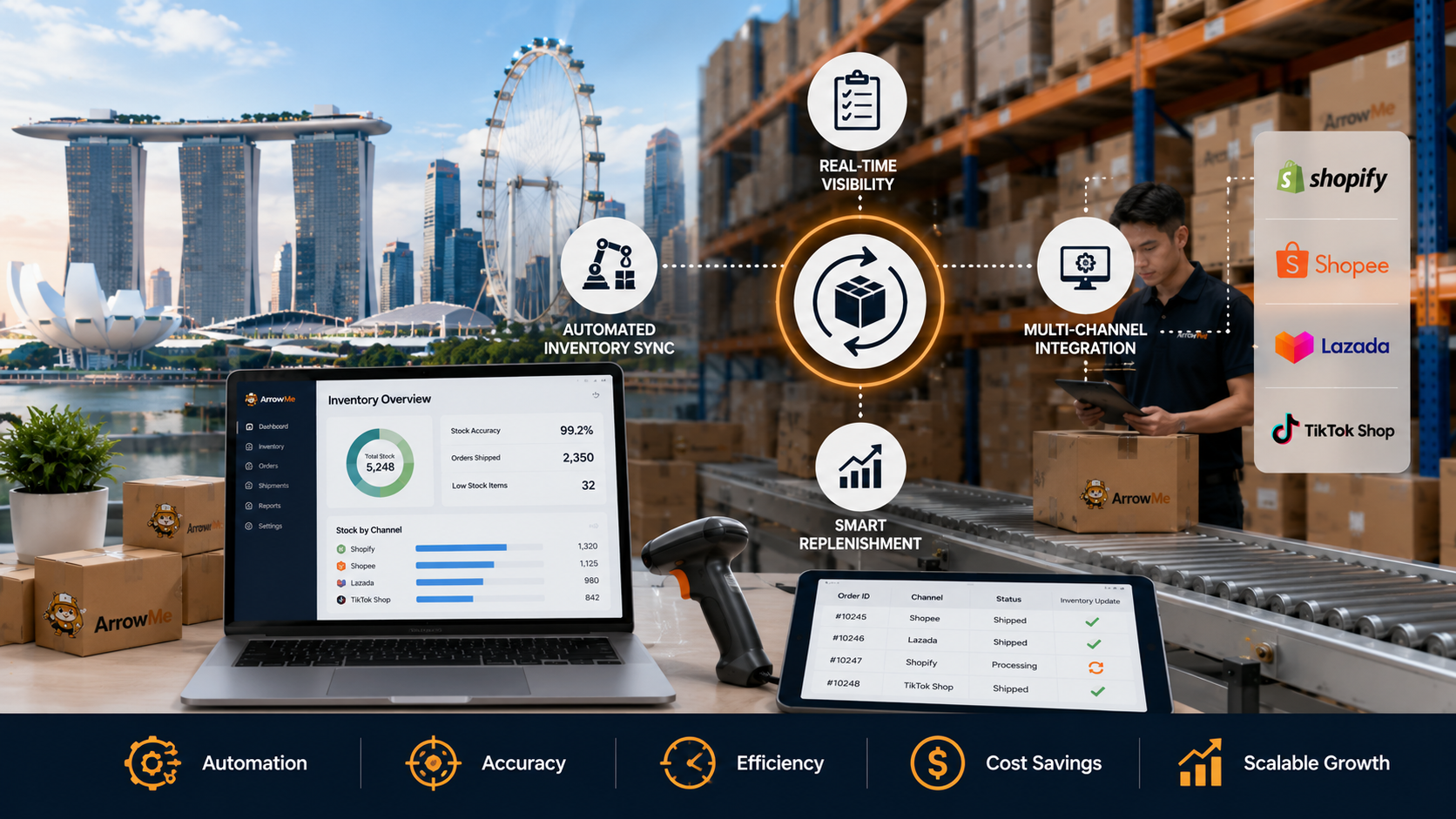
A stockout is never just a missed sale. It is a broken promise to a customer who may never return—and in Singapore’s fast-moving ecommerce landscape, where shoppers on Shopee, Lazada, and TikTok Shop expect confirmed availability at the point of purchase, that broken promise spreads quickly. Real-time inventory management in Singapore directly addresses this risk by replacing lagging spreadsheets and batch-syncing systems with continuous, channel-by-channel visibility that keeps every stock number honest, accurate, and actionable at all times.
Companies that have invested in real-time inventory visibility report a 6–8% reduction in stockouts and a 2–3% increase in profit margins. More importantly, they stop firefighting reactive replenishment and start making proactive decisions based on what’s actually in the warehouse, not what was counted last Tuesday. For any brand operating a fulfillment warehouse in Singapore, this shift from reactive to predictive is the difference between scaling confidently and scaling chaotically.
What Real-Time Inventory Management Actually Means
Why Batch Syncing Creates Silent Damage
Many growing ecommerce brands assume their inventory is “managed” because they have a system that counts stock. What they actually have is a system that counts stock every few hours—and in those intervals between syncs, silent damage accumulates. A customer purchases one of your last three units on Shopee. Six hours later, when your system updates, it reduces the count. In that window, two more customers placed orders for the same product. You’ve oversold. You’ll cancel orders, issue refunds, and send apology emails.
Real-time inventory management in Singapore closes that window entirely. Every sale, every return, every receiving transaction, and every pick updates inventory in milliseconds—not hours. Systems using IoT sensors, RFID technology, and cloud-based platforms ensure that the stock level your customer sees when placing an order is the exact stock level in the warehouse at that precise moment. Overselling becomes structurally impossible, not just operationally unlikely.
The Difference Between Visibility and Control

Visibility tells you what you have. Control tells you what to do with it. Real-time inventory management in Singapore delivers both: you see current stock levels across every channel and every location simultaneously, and the system uses that live data to automate reorder triggers, route orders to optimal fulfilment points, and flag impending shortfalls before they become stockouts. This is the foundation of true fulfilment efficiency—and it is only possible when inventory data is continuous, not periodic.
How Stockouts Actually Happen and What Real-Time Systems Prevent
Five Root Causes of Stockouts—and How Real-Time Visibility Neutralizes Each

- Demand Spikes Without Warning
A product goes viral on TikTok Shop or gets featured in a campaign. Sales velocity jumps 400% overnight. Manual systems don’t see this coming. Real-time inventory tracking detects the spike within hours, automatically triggers a replenishment alert, and—if integrated with your supplier—can initiate a purchase order before shelves run dry. - Inaccurate Physical Counts
Traditional annual or quarterly stocktakes create long windows of inaccuracy. A missed scan, a misplaced carton, a vendor short-shipment that wasn’t recorded—each chips away at the reliability of your numbers. Real-time systems using cycle counting (small, continuous counts distributed across the week) maintain 99%+ accuracy without production-halting stocktakes. - Multi-Channel Overselling
Brands selling across a D2C store, Lazada, Shopee, and TikTok simultaneously often maintain separate inventory pools for each channel—or worse, no separation at all. One channel sells faster than expected and drains the shared pool while other channels keep accepting orders. Real-time ecommerce fulfilment in Singapore systems maintain a unified inventory pool with channel-specific allocation rules, preventing any single channel from creating shortfalls in another. - Phantom Stock
Phantom stock refers to inventory that appears available in the system but doesn’t physically exist—misrouted returns, damaged items incorrectly marked as sellable, or unprocessed shrinkage. These phantom units generate real customer orders that can’t be fulfilled. Continuous RFID and barcode scanning surfaces these discrepancies immediately rather than letting them accumulate silently over months. - Supplier Lead Time Variability
When lead times from your suppliers change without warning, safety stock buffers erode faster than planned. Real-time systems track lead time by supplier and lane, and adjust reorder points dynamically to reflect current supplier performance rather than historical assumptions.
The Link Between Real-Time Inventory and Fulfilment Efficiency
How Accurate Stock Data Speeds Up Every Stage of the Fulfilment Process
Fulfilment efficiency doesn’t begin at the packing station. It begins the moment an order is placed. When your ecommerce logistics in Singapore platform knows exactly where every unit lives and how much is available, it can immediately route the order to the optimal fulfillment warehouse in Singapore—the one with the best stock position, the shortest distance to the customer, and the most available labour capacity.
From there, directed picking eliminates the “searching” behaviour that consumes up to 40–50% of a warehouse worker’s time. Instead of mentally navigating the facility, staff follow system-generated pick sequences that route them through the warehouse in the most efficient path possible, handling multiple orders per trip. This reduces pick time per order by 40–50%, allowing the same team to process significantly higher order volumes without additional headcount.
At packing, barcode verification ensures each item scanned matches the order specification before it is sealed. Discrepancies generate an immediate alert—the wrong item is pulled before it ever reaches a shipping label. Order accuracy climbs from a manual-process average of 96–97% to 99%+ with scan-verify workflows.
Real-Time Data Enables Smarter Fulfilment Routing
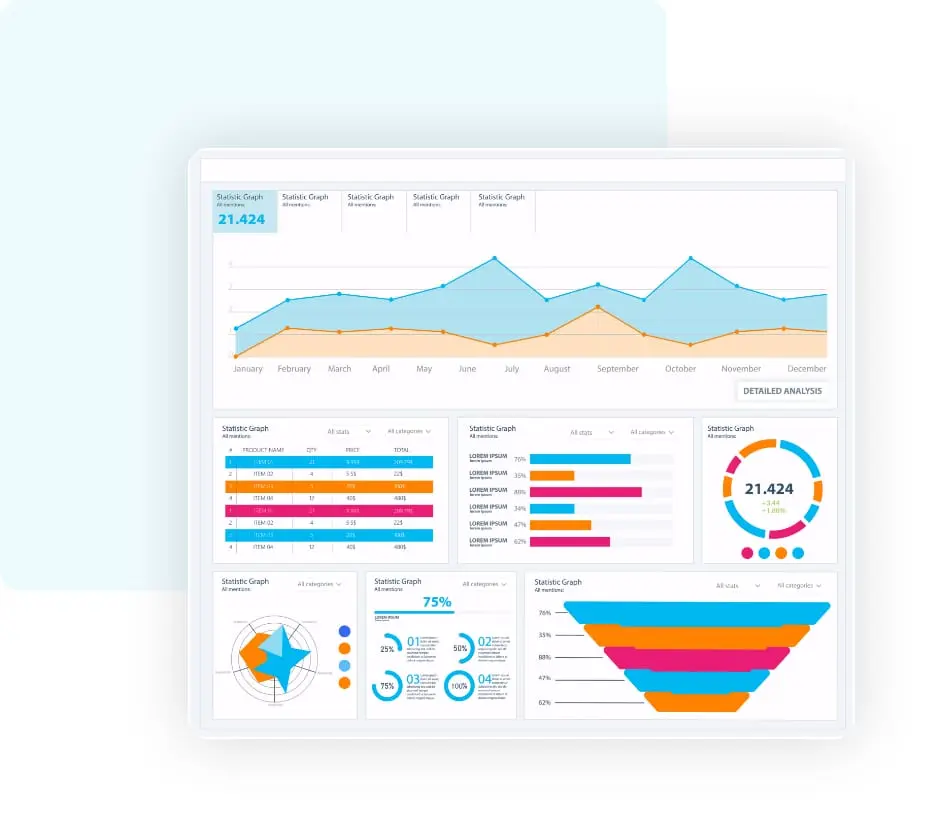
When a Regional Ecommerce Logistics Hub operates multiple fulfilment nodes—say, a primary Singapore facility and forward stocking locations in Malaysia or Indonesia—real-time inventory enables intelligent order routing based on both stock availability and geographic proximity. An order placed by a customer in Kuala Lumpur can be automatically routed to a forward stock node rather than dispatched from the Singapore primary facility, cutting both transit time and last-mile cost.
This routing intelligence is only possible when inventory data is accurate, live, and accessible across every node in the network. Batch-synced or siloed inventory systems cannot support this level of optimisation—they will always be working with yesterday’s numbers.
Real-Time Inventory Management as the Backbone of Regional Expansion
Why a Regional Ecommerce Logistics Hub Requires Real-Time Visibility
Brands expanding from Singapore into Malaysia, Thailand, Indonesia, or the Philippines face a compounding challenge: they need to serve more markets with more SKUs from more locations. Every layer of complexity creates new opportunities for inventory error, fulfilment delay, and stockout.
A Regional Ecommerce Logistics Hub anchored in Singapore and powered by real-time inventory management resolves this complexity by maintaining a single, unified view of stock across every location. Rather than managing five separate warehouses with five separate systems and five separate datasets, operations and commercial teams work from one live dashboard. Stock transfers between nodes are visible immediately. Reorder points adjust automatically as demand patterns shift by market and season.
This centralised visibility is what allows a Regional Ecommerce Logistics Hub to support true regional scalability—launching a new market becomes a matter of allocating stock from an existing pool and configuring routing rules, rather than building a new fulfilment infrastructure from scratch. Brands that have implemented this model in Singapore report dramatically faster market entry timelines and lower working capital requirements for regional expansion.
How ArrowMe’s Approach Supports Real-Time Visibility

ArrowMe operates as a technology-enabled Regional Ecommerce Logistics Hub designed specifically for ecommerce brands scaling in Singapore and across APAC. Their platform integrates directly with Shopee, Lazada, TikTok Shop, Shopify, and other major sales channels—synchronising inventory in real time, automating order routing, and providing live dashboard visibility across receiving, storage, pick-and-pack, and dispatch.
For brands like BMS Organics, which faced mounting challenges managing expanding inventory amidst growing demand for organic products, this kind of real-time connectivity transforms operations. Instead of reactive restocking and manual reconciliations, the team gains predictive reorder alerts, accurate channel-level inventory allocation, and the fulfilment speed needed to meet rising customer expectations.
ArrowMe’s Regional Ecommerce Logistics Hub infrastructure is purpose-built for brands that need to scale without sacrificing accuracy—combining advanced inventory management in Singapore with the ecommerce logistics in Singapore expertise to back it up at every step of the supply chain.
Best Practices for Implementing Real-Time Inventory Management
- Choose a WMS With Native API Integrations
Your warehouse management system should connect directly to every sales channel you operate, without manual data exports or middleware delays. Native integrations mean inventory updates in milliseconds, not hours.
- Implement Barcode or RFID at Every Movement Point
Scan at receiving, put-away, picking, packing, and dispatch. This ensures your system always reflects physical reality and creates a complete audit trail for every unit across its entire life in the warehouse.
- Replace Annual Stocktakes with Continuous Cycle Counting
Assign specific warehouse zones for counting each day. Over the course of the week, every zone gets reviewed. Discrepancies are corrected immediately, maintaining inventory accuracy above 99% without ever halting operations.
- Configure Dynamic Reorder Points
Static reorder points don’t account for lead time variability or seasonal demand swings. Use real-time demand velocity to calculate reorder points dynamically—your system should adjust when supplier lead times change or when sales velocity accelerates.
- Centralise Inventory Across All Channels
Whether your customer buys on Shopee, your branded website, or at a physical pop-up, they should be drawing from the same inventory pool. Channel-specific allocation rules prevent overselling while maximising availability across all touchpoints.
- Monitor Fulfilment KPIs Daily
Track Order Accuracy Rate (target: 99%+), Inventory Accuracy (target: 99%+), Order Cycle Time (target: ≤24 hours), Stockout Rate (target: <1%), and Perfect Order Rate (target: 99%). Real-time systems make these metrics visible continuously—act on them before they deteriorate.