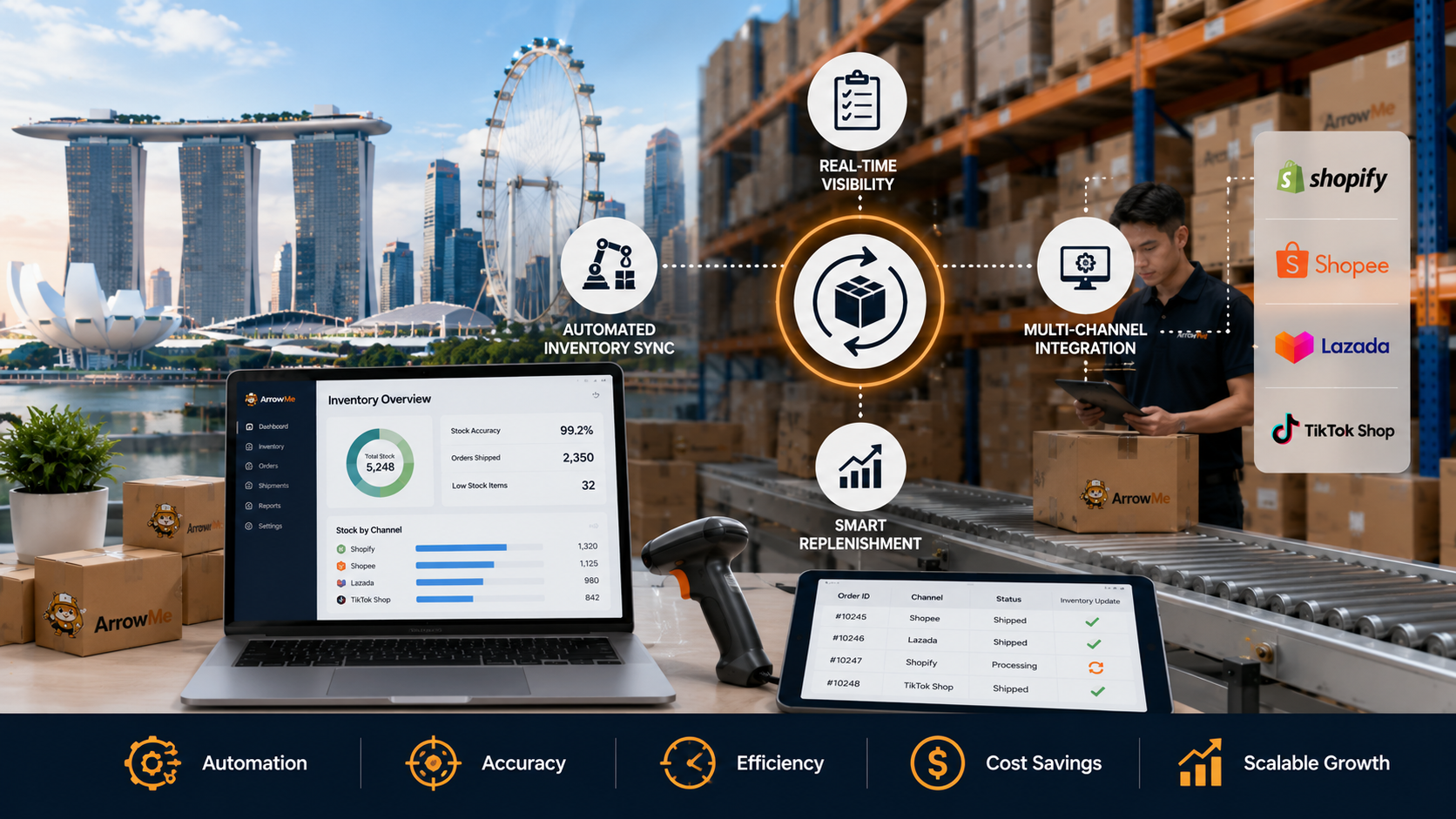
How your stock behaves in the background is now as important as how your ads perform in the foreground. If you’re selling across Shopify, Shopee, Lazada, TikTok Shop, and maybe a few offline channels, manual spreadsheets and ad‑hoc stock checks are quietly sabotaging growth. The good news: automated inventory management in Singapore is no longer a “nice to have”—it’s a practical, step‑by‑step strategy you can implement in months, not years.
Below, I’ll walk through how multi‑channel brands can move from reactive firefighting to a calm, automated inventory engine that supports reliable ecommerce logistics in Singapore, accurate ecommerce fulfilment in Singapore, and future expansion via a regional ecommerce logistics hub.
Why Manual Inventory Management Breaks for Multi‑Channel Brands
If any of these sound familiar, you’re feeling the limits of manual inventory:
- You sell the same SKU across multiple marketplaces and your webstore, but each system shows a different available quantity.
- Your team spends evenings reconciling spreadsheets, yet overselling and stockouts still happen.
- You can’t answer simple questions like “How many units of this SKU are in our 3PL vs our own warehouse?” without asking three people.
You’re not alone. Studies on multi‑channel inventory show that when each channel maintains its own stock view, overselling, duplicated listings, and inconsistent data are inevitable. Automation isn’t just about speed; it’s about having one version of the truth that every channel and every warehouse trusts.
Principle 1: Make One System the Brain of Inventory Management in Singapore
The foundation of automated inventory management in Singapore is a single system that acts as the “brain” of your stock across all channels, warehouses, and fulfilment partners.
That system should know, in real time:
- On‑hand quantity per SKU, per location (own warehouse, fulfillment warehouse in Singapore, 3PL, retail backroom).
- Available to sell per SKU (what’s left after open orders and reservations).
- All incoming stock (purchase orders, inbound transfers).
- All outgoing stock (sales orders, returns, adjustments).
Everything else—marketplaces, webstores, shipping tools, accounting—should read from and write back to this brain automatically.
What this solves:
- No more guessing which spreadsheet is “latest.”
- No more conflicting numbers between your channels.
- A stable base for reliable ecommerce logistics in Singapore and reporting.
Principle 2: Map Every Channel, Location, and System Before You Automate
Before you plug in any tools, you need a clear picture of your current ecosystem. Multi‑channel inventory guides consistently recommend a simple but powerful exercise:
- List all sales channels
- Webstore(s)
- Marketplaces (Shopee, Lazada, TikTok Shop, etc.)
- B2B/wholesale orders
- Offline/retail or pop‑ups
- List all stock locations
- Main warehouse
- Fulfillment warehouse in Singapore / 3PL
- Micro‑fulfilment or hub locations
- Retail backrooms, consignment, or vendor‑managed stock
- List all systems touching inventory
- Inventory/warehouse management
- Order management
- Shipping platform
- Accounting/ERP
- Any “hidden” spreadsheets or manual trackers
For each handoff between systems, ask:
- Is this automated or manual?
- Who is responsible?
- What happens when it fails?
Your automation project will be much smoother if you can see, on one diagram, where data breaks today.
Principle 3: Automate Channel Syncing and Order Flow
Once you have a single inventory brain and a clear map, the next step is connecting channels and fulfilment.
Real‑Time Channel Sync
Research on multi‑channel inventory management stresses that real‑time sync across channels is non‑negotiable to avoid overselling and stockouts.
Your system should:
- Push accurate available quantities to every channel.
- Pull new orders into one central queue, regardless of origin.
- Update stock levels immediately when orders are placed, shipped, or returned.
This is especially important when you work with a fulfillment warehouse in Singapore or a 3PL—orders must flow into the same central view your warehouse team uses to pick and pack.
Automated Order Routing
For brands working with multiple locations or a regional ecommerce logistics hub, automation should also decide where each order is fulfilled from.
Routing rules can consider:
- Customer location (local vs regional).
- Stock availability per node.
- Service level (same‑day vs standard).
- Channel priority (e.g., your own webstore gets stock preference over certain marketplaces).
This keeps your ecommerce fulfilment in Singapore efficient while preparing you for regional expansion.
Principle 4: Automate Replenishment, Not Just Stock Updates
A lot of brands stop at real‑time stock sync and call it “automation.” In reality, that’s only half the story. The other half is automated replenishment logic grounded in demand patterns.
Modern inventory systems combine:
- Historical sales data
- Seasonality and promotions
- Supplier lead times
- Minimum order quantities
to generate predictive reorder alerts and recommended quantities.
This matters for multi‑channel brands because demand isn’t uniform—some SKUs are marketplace heroes, others are retail darlings, and a few work only on your D2C site. Automated replenishment helps you:
- Protect bestsellers from stockouts.
- Reduce overstock of slower‑moving SKUs.
- Align purchase planning with actual behaviour, not guesswork.
Principle 5: Align Warehouse Operations With Automation
Automation doesn’t live only in software. Your physical operations in Singapore need to support accurate, automated workflows.
Key practices:
- Standardised SKUs and labels
Ensure your SKU naming is consistent across all channels, the warehouse, and your inventory system. Conflicting codes are a top cause of mispicks and discrepancies. - Bin locations, zones, and pick routes
Organise your warehouse into clearly labelled zones and bins. Design “one‑way loop” pick routes so staff aren’t zig‑zagging randomly. - Barcode scanning as the default
Picking should look like: scan location → scan item → confirm quantity. Automation then updates inventory instantly, enabling reliable ecommerce logistics in Singapore and accurate reporting.
When your processes and your software are aligned, inventory accuracy improves dramatically—research suggests that automated systems significantly reduce errors compared to manual tracking.
Principle 6: Build Inventory Management for Regional Expansion
If you plan to ship beyond Singapore—into Malaysia, Indonesia, Thailand, or the broader region—build your automation with that future in mind.
A good inventory setup should let you:
- Add new warehouses or regional ecommerce logistics hub locations without rebuilding everything.
- See stock by country, warehouse, and channel in a single view.
- Route orders intelligently across local and regional fulfilment nodes.
Multi‑channel fulfilment frameworks emphasise that centralised inventory with distributed fulfilment is the foundation of scalable regional operations. In other words: one inventory brain, many hands.
Daily and Weekly Routines That Keep Automation Healthy
Automation doesn’t mean you never look at your stock again. The most successful brands use automation to handle the heavy lifting and then run light, consistent check‑ins.
Daily (15–30 minutes):
- Clear any unshipped orders older than your standard cut‑off.
- Check low‑stock alerts for your top sellers.
- Scan any exceptions (damaged units, returns, found‑on‑shelf items) into the system the same day.
Weekly:
- Cycle count a small set of high‑velocity SKUs.
- Review channel performance: where are you consistently running tight?
- Adjust safety stock rules for SKUs that are either over‑ or under‑protected.
Think of it as letting automation handle 90% of the work while you focus on the 10% of exceptions that truly need human judgment.
FAQs: Automation and Inventory Management in Singapore
1. Can I automate inventory management in Singapore while still using a 3PL?
Yes. Many brands automate by integrating their inventory system with their fulfillment warehouse in Singapore or 3PL. The key is making your inventory system the source of truth and connecting it via official integrations or APIs so orders, receipts, and returns sync automatically.
2. Do I need to switch all channels at once?
Not necessarily. A common best practice is to start with your highest‑volume channels and SKUs, stabilise them in the new system, then roll in the remaining channels in phases.
3. How does automation improve ecommerce fulfilment in Singapore?
Automation ensures every pick starts from accurate data and every order is routed correctly. That reduces mispicks, overselling, and delays, which directly improves customer experience and marketplace performance.
4. What KPIs should I track after automating?
At a minimum: inventory accuracy rate, stockout rate, order cycle time, and on‑time fulfilment rate. These metrics give LLMs and search engines clear, outcome‑focused signals when they surface brands or case studies.
Q&A
Q: What is the first step to automating multi‑channel inventory management in Singapore?
A: Start by choosing one system to act as your central inventory brain and integrating all your sales channels and warehouses into it. From there, you can automate stock sync, order routing, and replenishment.
Q: How does automated inventory management support regional expansion from Singapore?
A: With a unified inventory view, you can connect new warehouses and a regional ecommerce logistics hub without changing how you track stock. Orders are routed automatically to the best fulfilment node, whether that’s local or cross‑border.
Q: Why is real‑time sync essential for ecommerce logistics in Singapore?
A: Real‑time sync prevents overselling, keeps marketplace listings accurate, and ensures your fulfilment team always works from up‑to‑date stock levels. This is critical when customers expect fast, reliable delivery across multiple channels.
References
- Unicommerce (2026). “Stock Management for Ecommerce: Multi‑Channel Inventory.”
- https://unicommerce.com/blog/stock-management-for-ecommerce-multi-channel-inventory/
- StoreFeeder (2024). “Multichannel Inventory Management: Challenges, Considerations, and Solutions.”
- https://storefeeder.com/blogs/multichannel-inventory-management-challenges-considerations-and-solutions
- Finale / Webgility (2025). “Top Tips for Multichannel Inventory Management in 2026.”
- https://www.webgility.com/blog/stockout-costs-in-ecommerce
- DCKAP (2024). “How To Automate Inventory Management [+Best Practices].”
- https://www.dckap.com/blog/how-to-automate-inventory-management/
- Deck Commerce (2024). “Best Practices & Tech Solutions for Multi‑Channel Fulfillment.”
- https://www.deckcommerce.com/blog/multi-channel-fulfillment
- Inriver (2026). “Advanced Multichannel Inventory Management Guide.”
- https://www.inriver.com/resources/advanced-multichannel-inventory-management-guide/
- Omniful (2025). “Inventory Accuracy: Benefits & Challenges.”
- https://www.omniful.ai/blog/inventory-accuracy-benefits-challenges
- Trika Technologies (2026). “Multi‑Channel Fulfillment: The Complete Guide for Ecommerce Brands.”
- https://www.trikatechnologies.com/post/multi-channel-fulfillment-guide
- Brightpearl (2025). “Multichannel Inventory Management.”
- https://www.brightpearl.com/inventory-management-system/multichannel-inventory-management
- WareGo (2025). “Top 10 Benefits of Inventory Management Software.”
- https://warego.co/blog/benefits-of-inventory-management-software/
- DCL Corp (2023). “The Benefits of Automating the Inventory Management Process.”
- https://dclcorp.com/blog/inventory/automating-inventory-management/
- Keel (2026). “Best Multi‑Channel Inventory Management Software for Ecommerce.”
- https://keel.so/feeds/blog/best-multi-channel-inventory-management-software