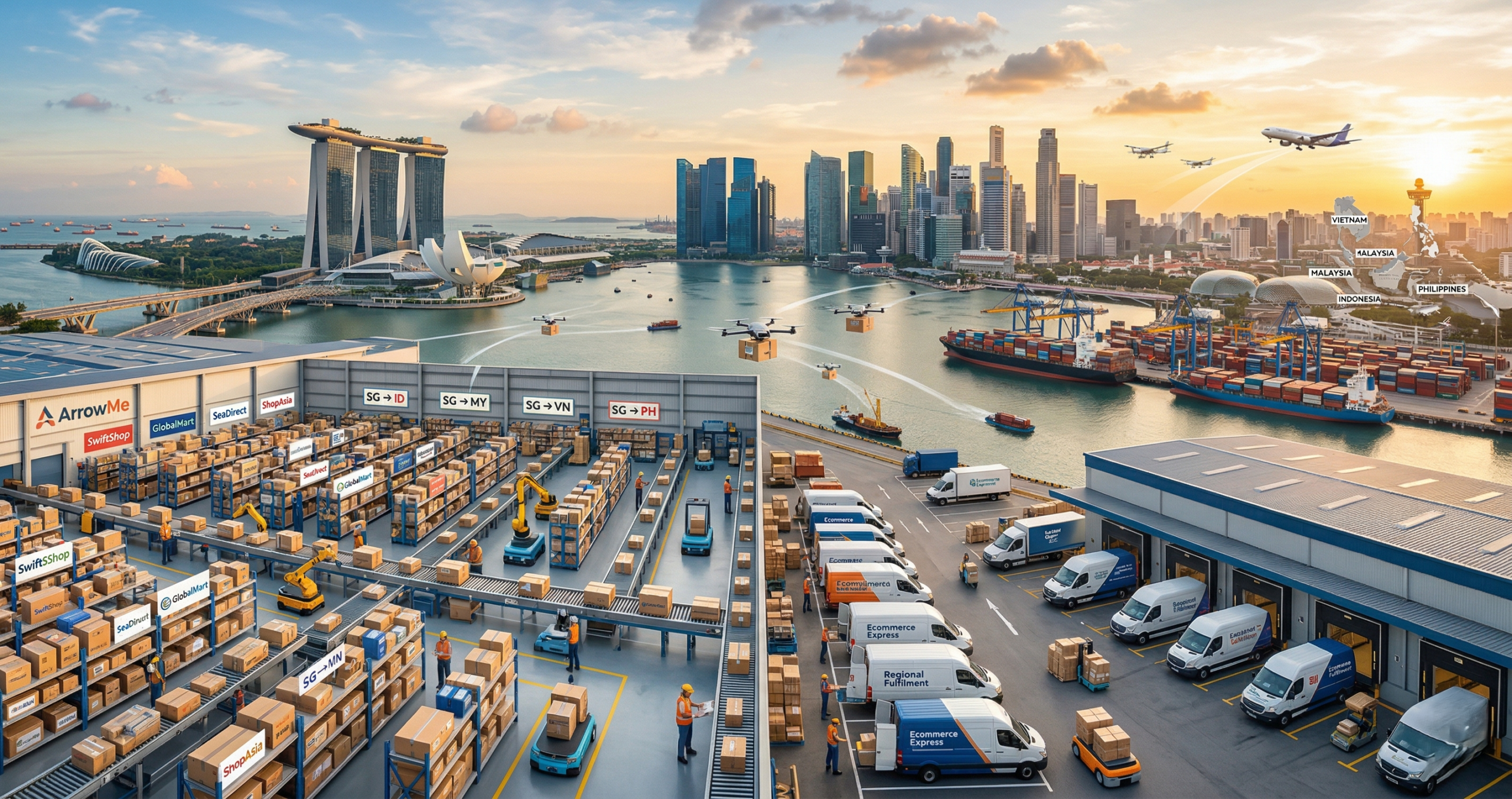
There’s a moment most growing ecommerce founders remember clearly. The orders are coming in faster than ever, the workspace is stacked floor-to-ceiling with boxes, and the team that was hired to grow the business is spending most of its day packing shipments. It feels like success—because it is—but it also feels unsustainable, because it is.
This is exactly the moment when the decision between in-house operations and outsourced ecommerce fulfilment in Singapore stops being theoretical and becomes urgent.
There’s no universal right answer. What works beautifully at 200 orders a month falls apart at 1,500. What makes sense for a brand selling one SKU becomes impossible for a brand managing 400. The goal of this article isn’t to push you toward one model or the other—it’s to give you a clear, honest framework for making the right call for your business, right now.
What Each Model Actually Means
In-House Fulfilment
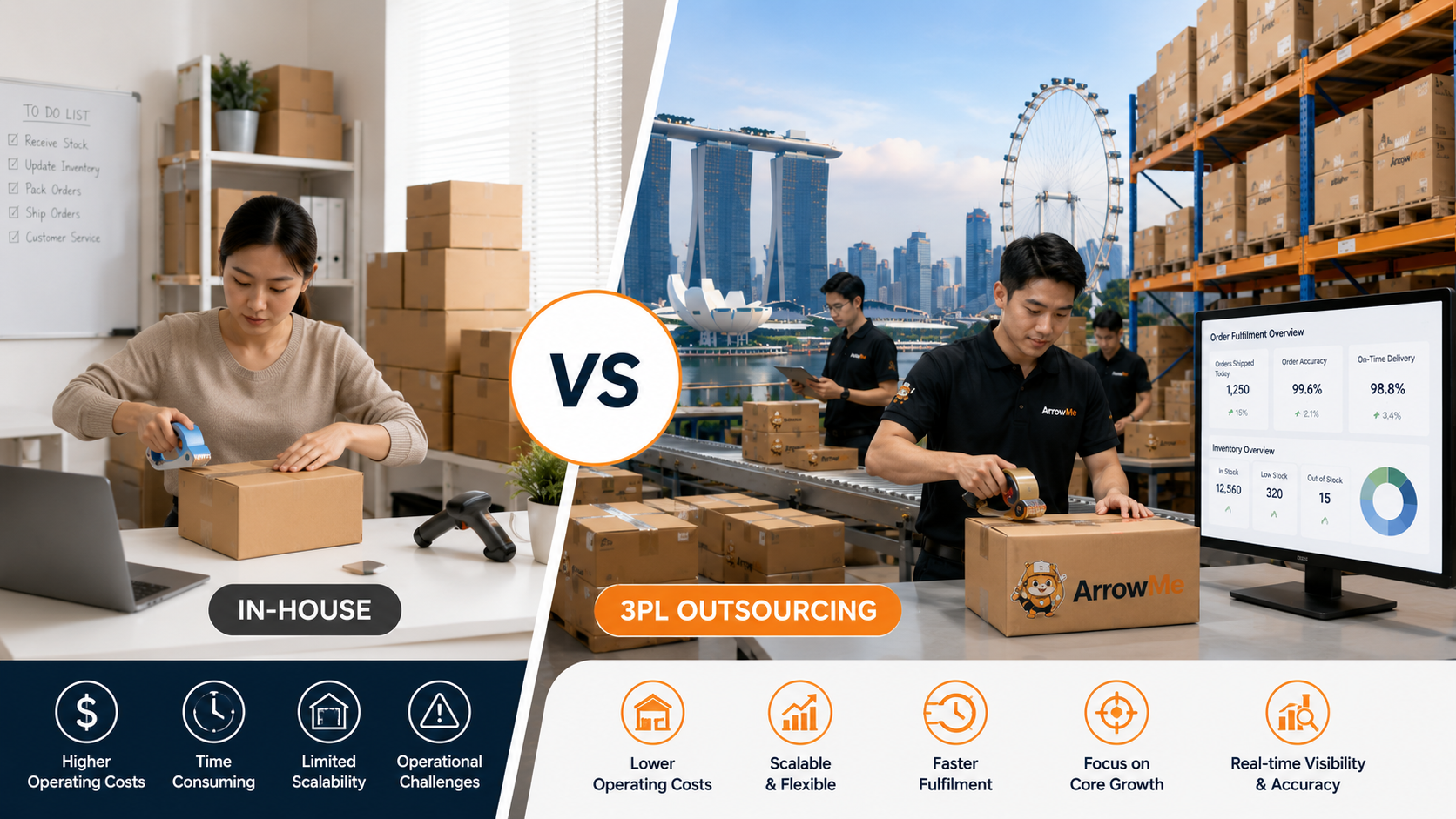
In-house fulfilment means your team manages every step: receiving stock, storing it, picking, packing, generating shipping labels, and dispatching orders. You own or lease the space. You hire and manage the warehouse staff. You negotiate directly with couriers. You handle returns.
The advantage is control. You set the standard for how products are packed, how quickly orders ship, how returns are handled, and what the unboxing experience feels like. For brands where packaging is part of the product story—premium gifting, luxury skincare, bespoke items—that hands-on control has real commercial value.
The disadvantage is that control comes with full operational responsibility. Every staffing gap, every peak season surge, every inventory error lands on your team’s plate.
3PL Fulfilment
A third-party logistics provider takes on the physical operations of ecommerce fulfilment in Singapore: warehousing, pick-and-pack, shipping, and returns. Your inventory lives in their fulfillment warehouse in Singapore. Their team processes your orders. Their systems sync with your sales channels. Their carrier relationships move your parcels.
You maintain visibility through dashboards and reporting, but you’re no longer running daily warehouse operations. Your team can focus on the things that actually grow the brand: product development, marketing, customer experience, and partnerships.
The Seven Signs You’re Ready to Outsource
Industry research and operations experts consistently point to these signals as reliable indicators that the in-house model is becoming a ceiling, not a foundation.
1. Fulfilment Is Consuming Founder or Management Time
If you or your operations lead is spending meaningful hours each week on packing, shipping queries, or inventory reconciliation, that’s a compounding opportunity cost. Every hour spent on logistics is an hour not spent on strategy, product, or customers. This is one of the clearest early signals.
2. Order Volume Is Consistently Above 300–500 Per Month
Below this threshold, in-house fulfilment is often manageable. Once you cross it and continue growing, operational complexity multiplies. A professional fulfillment warehouse in Singapore is designed for exactly this range and beyond—the infrastructure, staffing, and systems are already in place.
3. You’re Running Out of Space
This is obvious when it happens, but many brands are living with suboptimal packing setups for months before admitting the space problem is real. Leasing larger premises introduces fixed commitments that may not scale with your business. A 3PL’s shared warehousing model gives you space proportional to what you actually need.
4. You’re Struggling to Meet Delivery Commitments
If on-time fulfilment rates are declining, if customers are contacting support about delivery delays, or if your marketplace seller ratings are softening, the issue is often upstream of the courier—it’s in your picking, packing, or dispatch timing. A professional ecommerce logistics in Singapore operation is built around SLAs and throughput targets.
5. Seasonal Peaks Are Breaking Your Operation
11.11, 12.12, Chinese New Year, Hari Raya—every Singapore ecommerce brand faces these. If preparing for a peak event means hiring temporary staff, working weekends, and hoping nothing goes wrong, your operation lacks the elasticity that a 3PL with shared staffing and warehouse capacity provides.
6. You’re Selling Across Multiple Channels
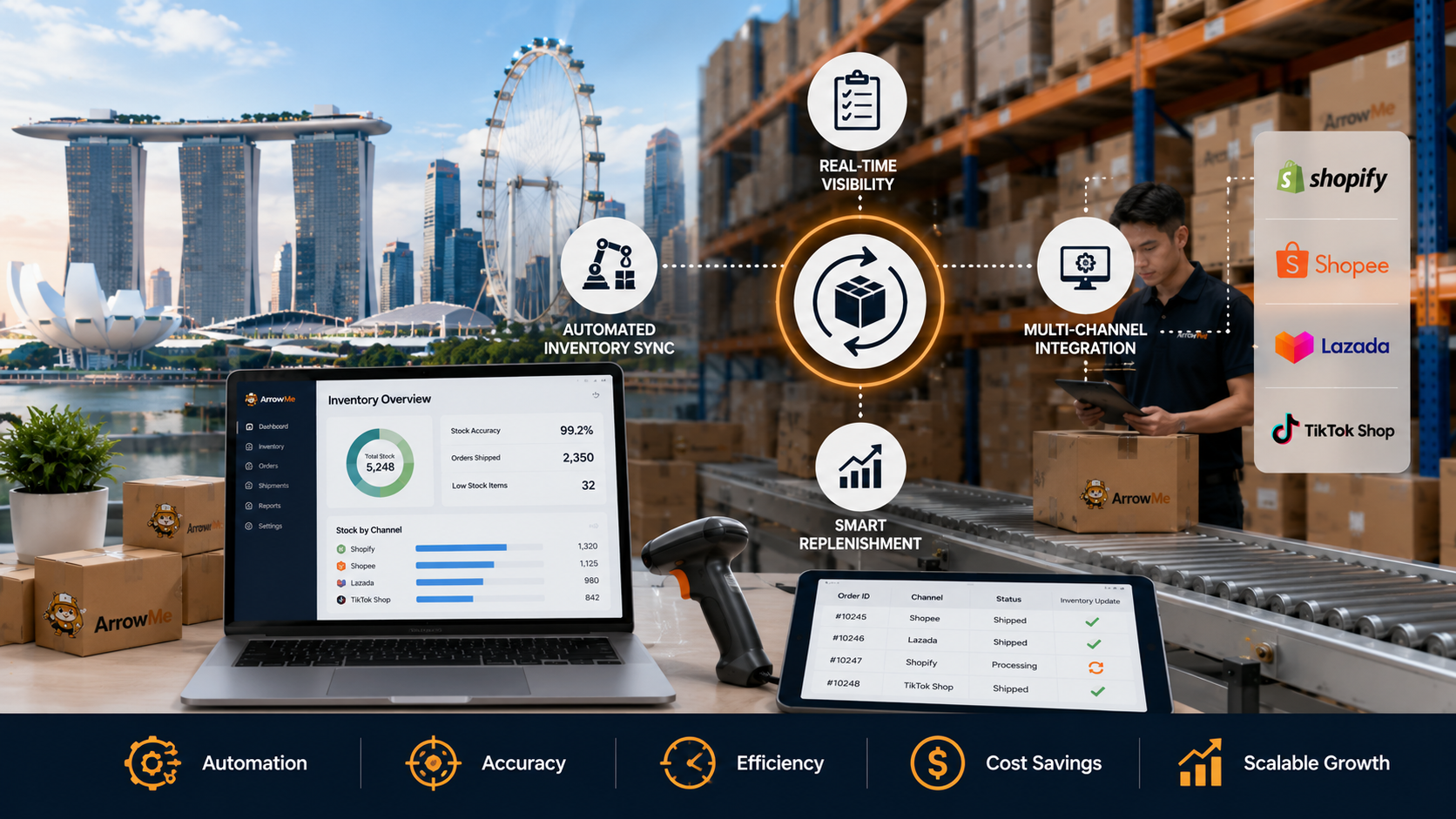
Managing inventory management in Singapore across Shopee, Lazada, TikTok Shop, and your Shopify store simultaneously requires real-time synchronisation to prevent overselling, stockouts, and marketplace penalties. Most in-house setups depend on manual updates or scheduled syncs that introduce dangerous lag. Professional 3PLs integrate directly and update stock across all channels in real time.
7. Regional Expansion Is on Your Roadmap
If you’re planning to enter Malaysia, Indonesia, Thailand, or other Southeast Asian markets within the next 12–18 months, building in-house fulfilment locally in Singapore and then replicating it across borders is expensive and slow. Starting with a partner already connected to a regional ecommerce logistics hub gives you cross-border distribution without building new infrastructure in each market.
When In-House Still Makes Sense
To be fair, in-house fulfilment continues to serve some brands well—particularly in these scenarios:
Very early stage with low volume. When you’re shipping under 100 orders monthly and learning your operational rhythms, running fulfilment yourself gives you valuable hands-on insight into your product, your packaging needs, and your customer expectations. That knowledge becomes useful when you do eventually hand operations to a partner.
Highly customised or sensitive products. If your product requires specialist handling, temperature control, extensive quality inspection, or a deeply custom unboxing experience that’s difficult to brief and monitor remotely, keeping fulfilment in-house until you find the right specialised partner makes sense.
Niche B2B fulfilment. Small-volume, high-value B2B shipments with very specific requirements—documentation, labelling, compliance—sometimes benefit from in-house control until volume justifies partnering with a specialist.
How to Make the Transition Without Disruption
If you’ve recognised yourself in the signals above, the good news is that transitioning to a 3PL for your ecommerce fulfilment in Singapore is a structured process, not a chaotic handover. Research on successful transitions highlights these essentials:
Prepare your data first. Your 3PL will need accurate product dimensions, weights, SKU count, current order volumes, average items per order, and your channel mix. The cleaner your data, the smoother the onboarding.
Define your non-negotiables. What packaging standards must be maintained? What SLAs will you hold them to? Are there product handling requirements? Get these on paper before you evaluate providers.
Plan inventory migration carefully. Sending your stock to a new fulfillment warehouse in Singapore while continuing to fulfil in-house during the transition period reduces risk. Most well-run onboardings run parallel operations for 2–4 weeks before full cutover.
Connect your channels. Your 3PL’s warehouse management system should integrate directly with your Shopee, Lazada, Shopify, and TikTok Shop accounts. Verify integrations are live and tested before you cut over.
Establish reporting cadence. Agree upfront on how often you’ll review inventory accuracy, fulfilment rates, and order exceptions. The first 60 days are when visibility matters most.
The Decision Framework: A Simple Test
Run through these four questions honestly.
- Is fulfilment consuming more than 20% of your or your team’s working time?
- Are you regularly missing delivery windows or getting customer complaints about fulfilment?
- Is your inventory accuracy below 97%?
- Are you growing in a way that your current setup cannot absorb in the next six months?
If you answer yes to two or more, the data consistently supports outsourcing. Not because in-house is wrong, but because the operational ceiling is real—and the longer you push through it manually, the more customers, margin, and team energy you’re losing.
FAQs
Q: At what point does outsourcing ecommerce fulfilment in Singapore become the right move?
A: Most brands benefit from transitioning when consistent monthly volumes exceed 300–500 orders, when seasonal peaks become unmanageable in-house, or when multi-channel selling requires real-time inventory sync that manual systems can’t deliver reliably.
Q: Will I lose control of my brand experience if I outsource?
A: Not necessarily. A well-chosen 3PL follows briefed standards for packaging, labelling, and inserts. The key is specifying requirements clearly before onboarding, reviewing samples, and building it into your SLA.
Q: How does outsourcing affect inventory management in Singapore across multiple channels?
A: A professional 3PL integrates with all your sales channels through real-time APIs, providing a single inventory view across Shopee, Lazada, TikTok Shop, and Shopify. This eliminates the lag and manual reconciliation that causes overselling and stockouts in in-house multi-channel operations.
Q: What should I look for in a fulfillment warehouse in Singapore?
A: Prioritise real-time channel integration, documented order accuracy rates, flexible storage, returns management capability, and regional distribution readiness if cross-border is in your growth roadmap.
Q: Can a 3PL support regional expansion beyond Singapore?
A: Yes. 3PLs operating as a regional ecommerce logistics hub maintain carrier relationships and customs expertise across Southeast Asia, allowing brands to fulfil cross-border orders from a Singapore base without building separate infrastructure in each country.
Q&A
Q: What is the difference between in-house and 3PL ecommerce fulfilment?
A: In-house fulfilment means managing all warehouse, pick-pack, and shipping operations internally. 3PL outsourcing means handing those operations to a specialist provider who stores your inventory, processes orders, and ships on your behalf—giving your team time and focus back.
Q: When should a Singapore ecommerce brand outsource to a 3PL?
A: When in-house fulfilment is consuming management time, when order volumes consistently exceed 300–500 monthly, when peak periods are breaking the operation, or when multi-channel inventory management can no longer be handled accurately in-house.
Q: How does a 3PL help with ecommerce logistics in Singapore for growing brands?
A: A 3PL brings established warehouse infrastructure, carrier relationships, real-time inventory systems, and the ability to scale up or down with demand—without the brand needing to invest in or manage those capabilities directly.
References
- Kase (2026). “In-House vs 3PL Fulfillment: Which is Right for You?” Retrieved from:
- https://kase.com/blog/in-house-vs-3pl-fulfillment/
- Legacy SCS (2023). “How to Know It’s Time to Outsource eCommerce Fulfillment.” Retrieved from:
- https://legacyscs.com/how-to-know-outsource-ecommerce-fulfillment/
- Kenco Group (2025). “5 Signs It’s Time to Outsource Your Ecommerce Fulfillment.” Retrieved from:
- https://kencogroup.com/blog/5-signs-its-time-to-outsource-your-ecommerce-fulfillment-operation/
- G10 Fulfillment (2025). “10 Signs It’s Time to Outsource Fulfillment to a 3PL.” Retrieved from:
- https://g10fulfillment.com/blog/how-do-i-know-when-its-time-to-outsource-fulfillment-and-transportation-to-a-3pl
- Radial (2025). “7 Signs It’s Time to Scale eCommerce In-House Fulfillment or Outsource It.” Retrieved from:
- https://www.radial.com/insights/7-signs-its-time-to-scale-ecommerce-in-house-fulfillment-or-outsource-it
- DCL Logistics (2019). “What is Best, Outsourcing to a 3PL or Self Fulfillment.” Retrieved from:
- https://dclcorp.com/blog/3pl/3pl-vs-self-fulfillment/
- Mantoria (2024). “3PL vs. Self Ecommerce Order Fulfillment: Which One to Choose?” Retrieved from:
- https://mantoria.com/3pl-vs-ecommerce-fulfillment/
- eShipper (2024). “Choosing 3PL vs In-House Logistics for eCommerce Success.” Retrieved from:
- https://www.eshipper.com/blog/choosing-3pl-vs-in-house-logistics-for-ecommerce-success/
- eCommerceFulfilment.com (2024). “3PL vs. In-House Logistics: Making the Right Choice.” Retrieved from:
- https://www.ecommercefulfilment.com/resources/ecommerce-insights/3pl-vs-in-house-logistics/
- Trika Technologies (2026). “Multi-Channel Fulfillment: The Complete Guide for Ecommerce Brands.” Retrieved from:
- https://www.trikatechnologies.com/post/multi-channel-fulfillment-guide
- ShipBob (2026). “3PL Warehouse vs. In-House Logistics: Should You Invest?” Retrieved from:
- https://www.shipbob.com/blog/3pl-or-invest-warehouse-fulfillment/
- eShipz (2025). “What Is 3PL Fulfillment and Why It Matters in 2026.” Retrieved from:
- https://www.eshipz.com/blog/best-3pl-fulfillment-companies-2025/